



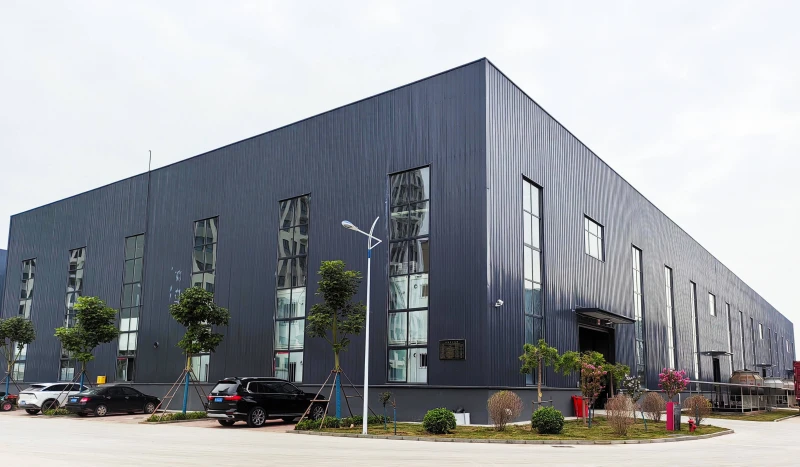
Far-Link headquarters is located in Zibo City, Shandong Province, is a research and development, design, production, sales as one of the trading group. The main production of Down Jackets, Ski Wear, Baby clothing and Middle East clothing, etc.
Our address
Zibo Far-Link International Trading Co., Ltd.
Phone Number
+86 13053338537
sales5@far-link.cn
Material pretreatment and fixation
Pre-shrinking treatment:
Lightweight fabrics (such as high-density nylon and polyester) need to undergo pre-shrinking treatment in advance to prevent dimensional deviations caused by temperature and humidity changes after cutting.
Stable material spreading:
Low-temperature hot-melt interlining or anti-slip interlining paper is combined with the fabric to enhance the fabric's stiffness and reduce sliding during cutting.
The fabric layers are fixed by using a Vacuum Cutting Table to ensure that each layer of fabric is closely adhered during multi-layer cutting.
Environmental adaptation:
Before cutting, the fabric should be left to stand in a constant temperature and humidity workshop (such as a temperature of 22℃±2 ℃ and a humidity of 55%±5%) for 24 hours to eliminate internal stress.
Selection of high-precision cutting equipment
Optimization of Automatic cutting machine
Oscillating Knife: It cuts thin and light fabrics through high-frequency vibration, reduces pulling deformation, and the accuracy can reach ±0.2mm.
Laser Cutter: Suitable for ultra-thin fabrics (such as 7D nylon), non-contact cutting avoids displacement, but attention should be paid to the edge hot melt treatment.
Tool parameter adjustment
Choose a sharp-angle blade with an Angle of 15° to 30° to reduce cutting resistance.
The cutting pressure is controlled at 20 to 40N, and the speed matches the characteristics of the fabric (such as 20m/min).
Digital templates and layout optimization
CAD intelligent layout
Use Gerber AccuMark or OptiTex software for AI layout to reduce fabric waste and ensure uniform gap (≥3mm) in the cut.
The quilting line area is compensated by layering, and the margin for filling and swelling is preset (usually 0.5 to 1cm is added horizontally).
Template reinforcement design
3D printed polymer templates (such as carbon fiber -PEEK composite materials), with magnetic strips embedded at the edges, are suitable for positioning on automatic cutting beds.
Laser positioning crosses are added to key parts (such as the brim and pocket), with an error of no more than 0.3mm.
Process control technology
Real-time monitoring system
Integrate machine vision (such as the Keyence CV-X series) on the cutting bed. Automatically compare the template data after cutting 5 pieces. An alarm will be triggered when the deviation exceeds ±0.5mm.
Use tension sensors to monitor the fabric laying status to ensure that the tension of each layer is consistent (difference < 5N).
Hierarchical clipping strategy
The first cut is to position the outer contour edge, and the second cut is to precisely cut the internal structural line.
Symmetrical cutting pieces adopt the mirror overlapping cutting method to ensure that the left and right pieces are completely consistent in one cut.
Personnel and environmental management
Specialized skills training
Operators need to pass the fabric slip coefficient test (for fabrics with COF < 0.3, they need to hold an advanced cutting certificate to work).
Establish a tool sharpness detection system every 2 hours (use a force gauge to monitor the changes in cutting force).
Environmental closed-loop control
Install the FFU laminar flow purification system to reduce the displacement of the cut pieces caused by the adhesion of suspended particles.
The ground is equipped with an anti-static coating (with a surface resistance of 10^6 to 10^9Ω) to prevent the misalignment of the cut pieces caused by static adsorption.
Post-verification mechanism
In the QC stage of the cutting pieces, non-contact 3D scanning (such as Hexagon Absolute Arm) is adopted. The deviation chromatogram is generated by comparing with the digital version, with key monitoring:
Seam alignment (allowable error ±1mm)
Consistency of quilting grid spacing (error ≤0.8mm)
Edge roughness of the cut piece (Ra value < 50μm)
Through the integration of the above technologies, the cutting accuracy of Lightweight Down Jacket For Lady can be controlled within ±0.3mm, the uniformity of down filling can be improved by 40%, and the rework rate can be reduced to less than 2% at the same time. It should be noted that the compensation values of the cut pieces corresponding to different gram weights of down (such as 600FP and 800FP) need to be adjusted dynamically. It is recommended to establish a material database for intelligent parameter matching.